
Atheron in Plain English
What we are building, why the graphics cards that secure it also run the AI on it, where the coin comes from, and the parts we would rather you heard from us.
- Document
- Plain-Language Paper v1.0
- Network
- Atheron · ATON
- Companion
- Technical paper, 44 pages
- Date
- 28 August 2026
Before you start
This is not an offer to sell you anything, and it is not advice. There is no public sale of ATON and there never was a private one. Nobody can buy it from us. The only ways to get it are to mine it or, once it is listed, to buy it from somebody who did.
Nothing here tells you what to do with your money. This document explains how a piece of software works. Mining, holding a coin and automated trading can all lose you money, and none of them are made safe by being explained clearly.
Some of this has not been built yet. Where something is a plan rather than a thing you can use, this document says so. Dates are given as months from the start of the build rather than as calendar dates, because a calendar date would suggest a confidence nobody has.
Nobody official has ruled on what ATON is. Atheron Network Inc. is a British Columbia company. How ATON is treated legally in Canada, the United States or anywhere else has not been decided by any regulator or court, and nothing here is a legal opinion.
If something in here is unclear, that is our fault and worth telling us about. The whole point of this document is that somebody can decide whether this is for them without needing a technical background.
01The short version
If you read one page, read this one.
Mining a cryptocurrency normally means running computers that solve puzzles. The puzzles have no purpose beyond being hard. The electricity is spent, the answer is thrown away, and the only thing produced is proof that somebody spent the electricity.
Atheron changes the shape of the puzzle. On one of its two mining lanes, the sums a graphics card has to do to win are the same kind of sums it does when running an AI model. Not similar. The same arithmetic, over the same sort of memory. So the card that is good at mining Atheron is exactly the card that is good at running AI.
That matters because the network also needs AI to be run. It has a trading engine, and that engine needs a lot of computation. Rather than renting that computation from a cloud company, the network buys it from the same people mining it, on the same machines. Your card mines when mining pays better and runs AI work when that pays better, and it decides continuously.
- The coin
- ATON
- 15 billion maximum, ever
- How to get it
- Mine it
- there is no sale, of any kind
- What it pays for
- Fees and AI work
- on the network
- Who holds your money
- You do
- we never touch it
The second thing worth knowing is what the trading engine does about the oldest problem in its category. Every automated trading product publishes its own results, which is like a student marking their own exam. Atheron writes every decision the engine makes onto the public blockchain at the moment it makes it, before anyone knows whether it was right. Anybody can go and read the whole list afterwards. That does not make the decisions good. It makes the claim about them checkable, which almost nothing else in this industry is.
02What problem this solves
Three things that annoy people, which turn out to have one answer.
Mining burns power for nothing
This is the criticism everybody has heard and it is basically fair. The security of these networks genuinely does come from the cost of the work, so the spending is not pointless. But the work itself is discarded.
Atheron does not claim to have fixed that in general, and you should be suspicious of anyone who says they have. What it does is narrower: the puzzle stays a puzzle, but it is shaped so that the machines that win at it are machines the network needs for something else anyway. The puzzle is still thrown away. The machines are not idle when they are not solving it.
AI compute is rented from a handful of companies
Running AI models needs powerful hardware, and most of it is rented from a very small number of very large companies. Several projects have tried to build a network of independently owned machines instead, and they usually run into the same wall: there is nothing for the machines to do, so the owners leave.
Atheron's network has work from day one, because its own trading engine needs AI constantly, and because the same machinery can answer other questions for other applications. And while that work is still building up, the machines are earning mining rewards anyway. That is the part that keeps people from leaving.
Trading products cannot prove anything
If you have looked at automated trading tools you have seen the screenshots. Impressive charts, big numbers, no way to check any of it. The company holding the results is the company that benefits from them looking good, and there is no independent record.
Writing every decision to a public blockchain before the outcome is known changes that. You cannot quietly delete the bad ones, because they are on a public list that would show a gap. You cannot add good ones afterwards, because each one is stamped with when it was written.
03How mining works, if you have never looked
Skip this if you already know. It is here because plenty of people own crypto without ever having had this explained, and the rest of the document assumes it.
The problem mining solves
A blockchain is a shared list of who owns what. The hard part is not storing the list, it is agreeing on it when nobody is in charge. If anybody could add to the list freely, somebody would add a line saying they own everything.
Mining makes adding to the list expensive. To add the next page, a computer has to find the answer to a puzzle, and the only way to find it is to guess enormous numbers of times. The puzzle is hard to solve and instant to check, which is the whole trick: everybody else can confirm you did the work in a fraction of a second.
Because guessing costs electricity, adding a false page costs real money. To rewrite history you would have to out-guess everybody else combined, continuously. That is what people mean when they say a chain is secured by mining: not that it is guarded, but that lying is more expensive than it is worth.
What the miner gets
Whoever finds the answer adds the page and is paid for it, in new coins. That payment is where the coins come from. There is no other source. When people say a coin is fairly launched, what they usually mean is that this is the only way any of it entered the world.
Why the puzzle's shape matters
The puzzle can be almost anything, as long as it is hard to solve and easy to check. Different chains pick different puzzles, and the choice decides what kind of machine wins. Some puzzles favour purpose-built chips. Some favour ordinary graphics cards.
Atheron picks a puzzle whose winning machine is a graphics card that is also good at running AI. Everything unusual about this project follows from that one decision, which is why it gets a chapter of its own.
04The four pieces
Each one works without the ones above it. That is deliberate.
| Piece | What it is | Why it is here |
|---|---|---|
| The chain | The blockchain itself. Records transactions, secured by mining. | Everything else sits on it. It works on its own, like any other blockchain. |
| The Compute Mesh | A network of graphics cards that run AI work and get paid for it. | This is where the mining hardware does its second job. |
| The trading engine | Software that watches markets and trades on your own exchange account. | The mesh's first big customer, and the product most people will actually use. |
| The Signal Ledger | A public list of every decision the engine makes, written as it happens. | What turns 'trust us' into 'go and look'. |
The chain does not need the trading engine to exist. The mesh does not need it either. The engine is the mesh's first serious customer rather than its excuse for existing, and if the engine were never built the other three would still work.
05Who is in charge
What keeps running if we disappear, what does not, and the one thing we can still change.
What does not depend on us
The chain, the Compute Mesh, the exchange and the public record of decisions all run on machines owned by other people. If this company shut down tomorrow, they would carry on. Your coins would be unaffected, because they were never ours.
What does depend on us
The trading engine's subscription and billing are ours, and they would stop. The website is ours. Support is ours. If we vanished you would lose the product and the service around it, and keep everything on the chain.
The one thing we can still change
Two parts of this are genuinely new: the graphics-card mining puzzle, and the piece that lets the two kinds of smart contract talk to each other. New means nobody has had a proper go at breaking them yet.
If either turns out to have a serious flaw and nobody can fix it, the network is stuck with a broken part forever. So we keep the ability to patch those two things and nothing else, with three conditions: any change is announced on the chain before it takes effect rather than after, everybody can see every time it is used, and the power is handed to community voting once the network is big enough and both parts have a track record.
06Mining, and why there are two kinds
One lane for purpose-built machines, one for graphics cards. They earn half the rewards each.
Lane A, for specialised machines
The first lane uses a conventional puzzle, the sort that purpose-built mining machines are very good at. This is normal mining and there is nothing unusual about it. It is here because specialised hardware is efficient, and because people who buy machines for one network specifically tend to stay.
Lane B, for graphics cards
The second lane is the unusual one. To win it, a card has to do a large number of matrix multiplications over a big chunk of memory. If that sentence means nothing to you, the only thing you need to take from it is: that is what running an AI model looks like from the outside. Same sums, same memory pressure, same kind of card.
So the hardware that wins Lane B is the hardware the Compute Mesh wants. That is not a happy accident, it is the entire design, and it is why this project exists in the shape it does.
07The trading engine
Two things reading the market, one set of your rules deciding what actually happens, and your money staying on your own exchange throughout.
What it looks at
- The charts. Price and volume across different time windows, reduced to a direction and a confidence level. This part is on every plan.
- The mood. An AI model reads social and news activity in several languages and scores it. Not an essay, a score. This part is on the higher plans.
- Both together. The two scores are combined using weights you choose, and the result is a decision: buy, sell or do nothing.
What decides what actually happens
The engine's decision is not the last word. Your own settings are. Before anything reaches your account it passes through your limits: how much one trade can use, how much can be open at once, and how far your balance can fall before everything stops. Those settings can only reduce what the engine wanted to do. They never increase it.
One more thing the software does that is worth knowing. Exchanges let you choose what a key is allowed to do. If you accidentally give us one that can withdraw money, the app checks, tells you, and refuses to use it. It does not accept it and promise to behave.
08The public record
Every decision written down as it happens, with nothing in it that says who you are.
When the engine decides something, that decision is written onto the blockchain straight away. Not a summary at the end of the month. The decision itself, at the moment it is made, before anybody knows how it turned out.
| What gets written down | What never does |
|---|---|
| Which coin it was about | Who you are |
| Buy, sell or hold | How much money you put in |
| How confident it was, and why | What price you got |
| Which version of the software decided | What is in your account |
| The exact time | Whether you made or lost money |
A public list of decisions is useful to everybody. A public list of your positions would be a permanent record of your finances with your name near it, and no amount of usefulness would be worth that.
09Why five machines have to agree
How the network gets a trustworthy answer out of computers owned by strangers.
If you ask one stranger's computer to run an AI model and tell you the answer, you have no way of knowing whether it did the work or made something up. Making something up is cheaper, so somebody will.
So the network does not ask one. It asks five, separately, without letting them talk to each other. Each returns its answer, and the job only counts if at least three of the five match. A machine whose answer disagrees with the majority loses a slice of its deposit.
   one job  ─┬─►  machine 1   ─►  answer A
             ├─►  machine 2   ─►  answer A
             ├─►  machine 3   ─►  answer A     three match  ✓
             ├─►  machine 4   ─►  answer B     loses 2% of its deposit
             └─►  machine 5   ─►  answer A

   for anything that can trigger a trade, it asks nine
   and needs six to agree
To cheat this you would need to control most of the machines picked for a particular job, without knowing in advance which ones would be picked, and while every one of them has money at stake. That is the whole security model, and it is the same machinery used when a smart contract needs to know a price from outside the chain.
10The coin
Fifteen billion, ever. Eighty per cent of it comes out of mining. None of it is for sale by us, now or later.
- Maximum ever
- 15,000,000,000
- ATON, fixed
- From mining
- 12,000,000,000
- 80% of the total
- Sold by us
- Nothing
- no sale, no private round
- Takes about
- 132 years
- to finish being issued
Where every coin goes
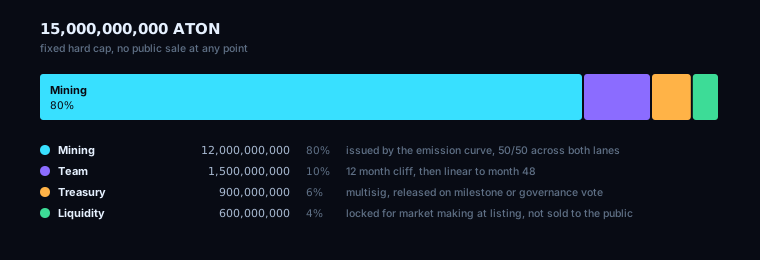
| Portion | How many ATON | What it is | When it becomes available |
|---|---|---|---|
| Mining | 12,000,000,000 | Paid out to miners, split evenly between the two lanes | Gradually, over about 132 years, on the schedule in the next chart |
| The team | 1,500,000,000 | Ours | Nothing for the first year. After that it unlocks gradually until year four |
| Treasury | 900,000,000 | For audits, grants and building things | Only when a specific milestone is met or a vote approves it. There is no schedule |
| Market liquidity | 600,000,000 | Locked, so the coin can actually be traded when it lists | At listing. Not sold to the public |
How mining pays out over time
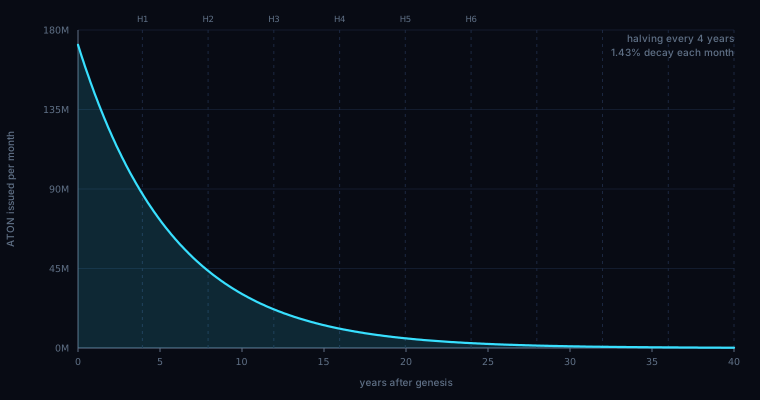
The amount paid to miners drops by 1.43% every month. That sounds small and it compounds: over four years it halves. Over about 132 years it runs out. If you know Bitcoin's schedule, this is deliberately the same rhythm and the same lifespan, just smooth instead of dropping off a cliff every four years.
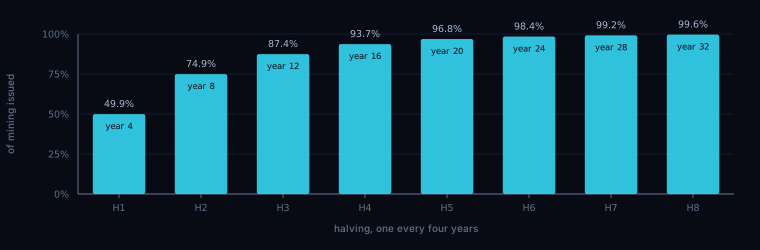
Half of all the mining rewards are paid out in the first four years. That is worth saying plainly because it is the number people go looking for. It is the same front-loaded shape Bitcoin has, and it means early mining is where most of the coin comes from.
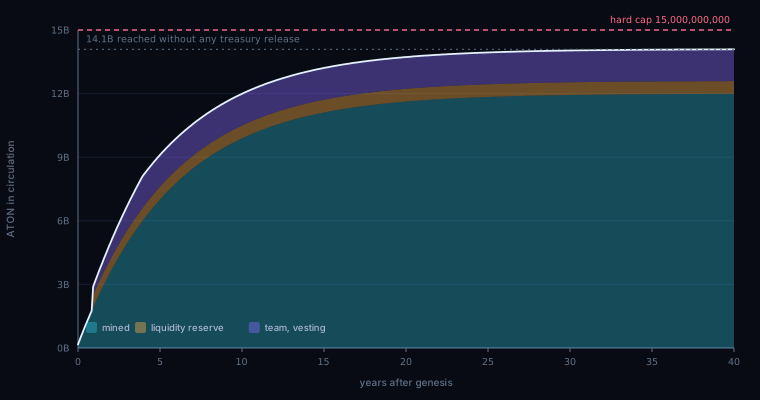
You may notice the total never quite reaches fifteen billion. That is the treasury: it only moves when a milestone is met or a vote passes it, so it has no schedule and does not appear as a curve. If it is never released, it is never created.
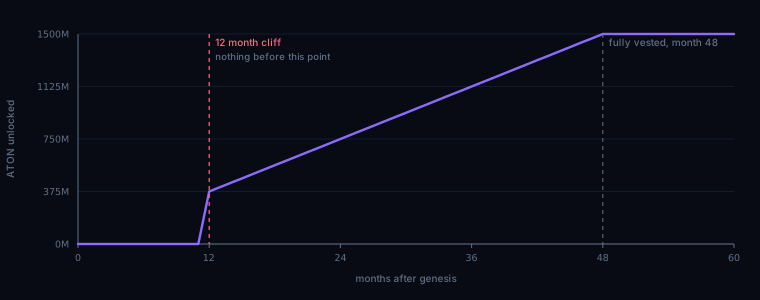
The team's coins are on the schedule above. It is a normal arrangement and the reason for it is straightforward: it means nobody on this side can take a large amount and leave in the first year, because there is nothing to take.
What the coin is for
- Paying network fees, the way you pay a fee on any blockchain.
- Paying for AI work on the Compute Mesh.
- Staking, if you run a mesh node. You put up at least 1,000 ATON as a deposit, and you lose a slice of it if your machine returns dishonest results.
- Voting on treasury spending and some network settings.
11What you can actually do
Four ways in, with what each one needs.
| If you want to | You need | You get |
|---|---|---|
| Mine with a graphics card | A reasonably modern card with tensor cores | A share of Lane B rewards, and the option to earn from AI work on the same card |
| Mine with specialised hardware | Mining hardware for the Lane A puzzle | A share of Lane A rewards |
| Run AI work | A graphics card and 1,000 ATON as a deposit | Paid per job. Your card mines when there is no work |
| Use the trading engine | A subscription and your own exchange account | The engine trades on your account, under your limits, with your keys never leaving your computer |
| Build something | The usual Ethereum tools, or Rust | A chain that can run AI work for your app |
None of the mining options need permission, an application or an account with us. You point hardware at the network and it works or it does not. Running AI work needs the deposit, because otherwise it would cost nothing to run dishonest machines.
12What it costs
Nothing is on sale yet. Here is the shape of it when it is.
Mining is free to start
No fee, no account, no permission. You point hardware at the network. What it costs you is electricity and what it earns you depends on things nobody controls.
Running AI work needs a deposit
At least 1,000 ATON, held as a bond. It is not a payment to us and we never hold it; it sits with the network and comes back when you stop, minus anything you lost for returning dishonest answers. The reason it exists is that without it, running lying machines would cost nothing.
The trading engine is a subscription
Four plans, monthly or yearly, starting at twenty-four dollars a month. What changes between them is how many exchanges you can connect, whether the second AI engine runs, how quickly your work is handled when the network is busy, and whether you can publish strategies for other people to follow. The full comparison is on the pricing page and is not repeated here.
If you publish a strategy and charge people to follow it, we take fifteen per cent of what you actually earn. If you publish for free, we take nothing, because there is nothing to take a share of.
13When
Months from the start of the build, not calendar dates, because we do not know the calendar dates.
| Roughly when | What arrives |
|---|---|
| Months 0 to 1 | Company, repositories, this website, the live build tracker, and the first two graphics cards running as the founding network |
| Months 1 to 4 | The blockchain itself, both mining lanes, an internal test network, then an invite-only test network |
| Months 2 to 6 | Smart contracts, and a public test network anybody can use |
| Months 4 to 7 | The Compute Mesh, staking, and voting |
| Months 7 to 9 | The real network launches, once every security audit is finished |
| Months 5 to 9 | The trading engine's first version, in closed testing |
| Months 7 to 12 | The full trading engine, the desktop app, the strategy marketplace and the exchange |
| Month 12 onward | Bigger AI models as more machines join, and handing control over to the community |
14What could go wrong
The things that would genuinely hurt, in plain words. This is not a formality and it is not everything.
The new mining puzzle might be broken
Lane B has never been attacked at scale because it has never run at scale. If somebody finds a shortcut, that lane becomes cheap to dominate and the puzzle has to be swapped out. There is a plan for doing that and it would still be disruptive. This is the single biggest technical risk in the project and we would rather list it first than bury it.
Two complicated things are launching at once
The part that lets the two kinds of smart contract talk to each other is being launched with the network rather than added later. On other projects that have tried this, that specific piece is where the worst bugs turned up. We are auditing it hard and launching it deliberately restricted, and it is still the component most likely to have something wrong with it.
Mining rewards drop fast
Half the mining rewards are gone in four years. If the network has not grown by then, there is less being paid to secure it. Bitcoin has the same shape and the same risk; it is not unique to us, and it is not nothing.
Nobody may want the AI work
Our own trading engine and the mining rewards keep the machines paid at the start. If no other developers ever want to buy AI work from the network, then the Compute Mesh is an expensive way to run one product, rather than the general utility it is meant to become.
The rules could change
No regulator anywhere has said what ATON is. We have designed around that as carefully as we can, and the strategy marketplace in particular needs proper legal review in Canada and the United States before it opens, which has not happened yet. If the answer comes back badly, features change.
We are small and this is a lot
Several hard things are being built at once, and the network cannot launch until every one of the security audits is finished. Plans in this field slip. Ours probably will too, and the tracker is there so you can watch it happen rather than be told about it afterwards.
15What we are not
Shorter than the list of what we are, and probably more useful.
- Not a way to make guaranteed money. We will never publish a projected return, because any number would be invented.
- Not holding your coins. Ever. We could not if we wanted to.
- Not a token sale. There is nothing to buy from us, there never was, and there is no plan for one.
- Not offering leverage. Spot trading only. No borrowed money, no liquidations, no route to either.
- Not a robot that predicts markets. It follows rules consistently without getting bored or scared. That is genuinely valuable and it is not the same thing as knowing what happens next.
- Not asking you to approve trades. It is automation. If you would rather approve each one, trading by hand will suit you better than any automated tool, including this one.
- Not finished. Almost none of this exists yet.
16Questions people ask
The short versions. The website has these in full, along with several more.
- Will it make me money?
- We will not give you a number, because any number would be a guess. What the software does is follow rules consistently without getting bored or frightened, which is genuinely useful and is not the same as a return.
- Can you take my coins?
- No, and not as a policy. We never hold them. Your exchange keys are scrambled on your own computer with a password we never see.
- What if I lose my password?
- Your key is gone and we cannot recover it. You make a new one at your exchange, which takes a couple of minutes. That we cannot help is the proof that we never had it.
- Is there borrowing or leverage?
- No. Spot only. No borrowed money and no route to any.
- Can I approve each trade first?
- No. It is automation, and you set the rules in advance. If you would rather approve each trade, trading by hand suits you better than any automated tool.
- What happens if your company fails?
- The chain, the network of machines, the exchange and the public record keep running, because none of them are ours to switch off. The subscription and support would stop.
- When can I use it?
- Around month nine of the build for the first closed version. The build tracker on the website is the honest answer at any given moment.
- Is this financial advice?
- No. None of it, anywhere, including this document.
17Where to look next
- The build tracker
- Calculated from the actual code rather than written by us. The honest answer to how far along this is.
- The changelog
- Every change, with what it was, why we did it and what it means. Written in English, not commit messages.
- The technical paper
- The same project with the specification detail. Forty-four pages, and it assumes you want them.
- The roadmap
- The phases in the timeline above, with what has to be true to call each one done.
- The community
- Where questions get asked and answered. If something here was unclear, that is the place to say so.
If you take one thing from this document, take the part that is easiest to check: every decision the trading engine makes is written to a public blockchain before anybody knows whether it was right. You do not have to believe us about that. That is rather the point of it.
18Words this document used
In plain terms, in the order you are likely to have met them.
- Blockchain
- A shared list of who owns what, kept by many computers at once so that no single one of them can rewrite it.
- Mining
- Competing to add the next page to that list by solving a deliberately hard puzzle, and being paid in new coins for winning.
- Hashrate
- How many guesses per second the whole network is making. More of it makes the network more expensive to attack.
- Difficulty
- How hard the puzzle currently is. It adjusts by itself so pages keep arriving at about the same rate.
- Lane
- Atheron has two separate mining competitions running side by side, one for purpose-built machines and one for graphics cards. Each is called a lane.
- Halving
- When the mining reward drops by half. Here it happens smoothly over four years rather than overnight.
- Compute Mesh
- The network of graphics cards that run AI work for the chain and get paid for it.
- Staking
- Putting up coins as a deposit that you lose part of if you misbehave. Here it is what lets a machine take AI work.
- Slashing
- Losing part of that deposit for returning a dishonest answer.
- Signal Ledger
- The public list of every decision the trading engine has made, written as each one happens.
- Non-custodial
- Nobody but you can touch your money. Proved here by us being unable to recover your key if you lose it.
- Spot trading
- Buying and selling the actual thing, with your own money. As opposed to borrowing to trade larger, which this does not do.
- Smart contract
- A program that runs on the blockchain itself rather than on somebody's server.
- Testnet
- A practice version of the network, using worthless coins, where things are allowed to break.
- Mainnet
- The real one.